
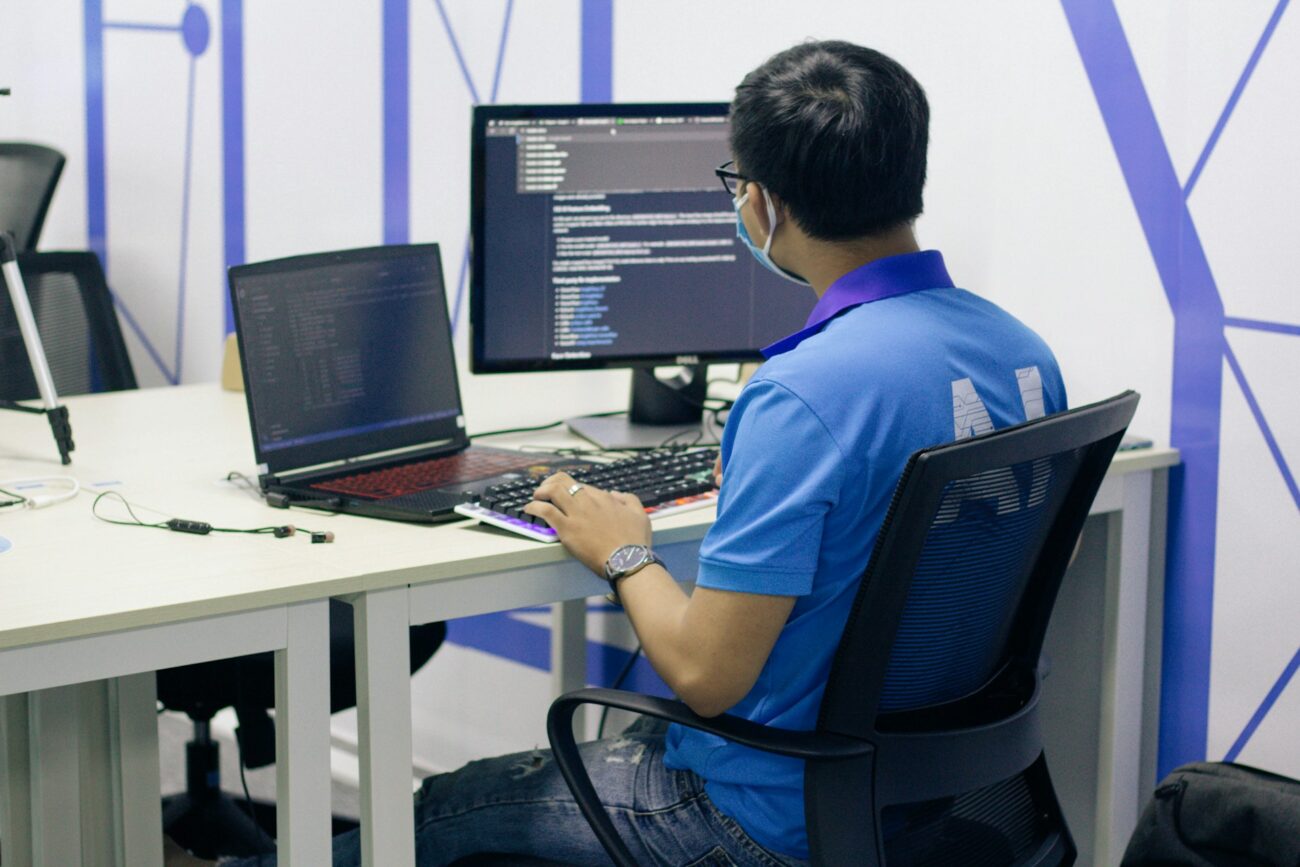
Most ML models never see production. They sit in Jupyter notebooks. They work on the engineer’s laptop. Then reality hits. Production is different. Latency matters. Data shifts. Models break at 3 AM. The firms below handle that messy reality.
Here are five machine learning development companies that ship models people actually use.
What Production Deployment Actually Requires
A notebook model and a production model are not the same thing.
Production ML needs five things:
- Containerized deployment with Docker or similar
- CI/CD pipelines that test models before shipping
- Monitoring for data drift and concept drift
- Scalable infrastructure that handles traffic spikes
- Rollback capabilities when something fails
The firms below have built all of this.
1. Avenga
Best for: Enterprise ML infrastructure with 100 percent legacy compatibility
Avenga is a machine-learning development company that addresses a specific pain point. Most ML firms build models. Few ensure those models talk to existing bank infrastructure. Avenga does both.
Take their work with Ayasdi, a machine intelligence firm serving Fortune 500 financial institutions. Ayasdi had powerful AI algorithms. But financial analysts could not easily use them. The existing setup required manual configuration. Single sign-on was missing. Workflow management was absent.
Avenga built the Modeler application from scratch. The team added five core features to a single interface. Pre-processing tools turn raw data into algorithm-ready input. Custom modeling lets data scientists build predictions based on their own criteria. Semi-automatic workflow management handles data transformation and model review. Post-processing tools compare predictions with control data.
The result runs with 100 percent compatibility on Ayasdi’s existing infrastructure. Single sign-on integration keeps security tight. Financial analysts now detect fraud and manage trading decisions without engineering help.
What makes Avenga different for production deployment:
- Builds for existing infrastructure, not greenfield projects
- Includes SSO and security from day one
- Delivers workflow automation so non-engineers run models
2. ScienceSoft
Best for: Production ML in regulated healthcare environments

ScienceSoft deploys ML models where mistakes cost lives. Their recent project involved a neural network-powered platform for liver graft analysis. A European medical device manufacturer needed real-time steatosis quantification during organ procurement. Surgeons cannot wait minutes for results. They need answers immediately.
ScienceSoft built a regression neural network on AWS. The platform runs across three components. An iOS mobile app captures spectrometer scans offline and syncs later. A web application lets senior surgeons review scans and make procurement decisions. An administrative panel manages platform settings and retrains models.
The deployment handles high-stakes scenarios. Internet availability varies in hospitals. The mobile app works offline. Data syncs when the connection returns. HIPAA and GDPR compliance runs through every layer. Apache PredictionIO orchestrates the model with Spark for distributed processing. Elasticsearch stores performance metrics for monitoring.
Production deployment features:
- Offline first mobile deployment for variable connectivity
- Role-based access for junior and senior surgeons
- Power BI dashboards with role-specific metrics
- Model retraining interface for administrators
3. BairesDev
Best for: Extreme scale ML deployment (billions of daily predictions)
BairesDev deploys ML at a scale most firms never touch. Their seven-year engagement with NextRoll proves it. NextRoll runs predictive analytics for ad auctions. The platform creates over 150 billion buyer predictions daily. It launches about 100,000 ad auctions per second on autopilot.
Finding engineers who understand that scale is hard. Python developers with deep statistical knowledge are scarce. BairesDev brought in 48 nearshore engineers from Latin America. They embedded data scientists, data engineers, and back-end developers across seven NextRoll teams.
The results speak for themselves. The ML technology now serves 50 billion ad impressions per day. Customer acquisition on Shopify jumped 60 percent. The engagement earned a perfect 10 out of 10 NPS score.
BairesDev’s ML services cover the full deployment lifecycle. They containerize models with Docker. They expose them through secure endpoints using FastAPI, Flask, or gRPC. Deployment targets include AWS SageMaker, Google Vertex AI, and Azure ML. Their MLOps practice handles model versioning, drift detection, and audit trails for governance.
Production deployment capabilities:
- 150 billion daily buyer predictions at scale
- 100,000 ad auctions per second
- 48 engineers embedded across seven teams
- Full MLOps with drift detection and audit trails
4. Simform
Best for: End-to-end MLOps pipeline automation
Simform treats model deployment as an engineering problem, not a science experiment. Their MLOps services focus on automation at every stage. They use Kubeflow for end-to-end ML workflow management. Apache Airflow handles data pipeline orchestration. CI/CD pipelines automate building, testing, and deployment.
Production models need constant attention. Data drifts. Concept drifts. Performance decays. Simform uses TensorFlow Model Analysis and Seldon Core to monitor models continuously. The system flags data drift, concept drift, and accuracy drops before they cause problems.
Their MLOps as a Service offering takes this further. Simform hosts and manages the entire MLOps infrastructure on demand. Clients focus on developing new ML solutions while Simform handles the plumbing. This works for enterprises that lack internal MLOps expertise.
Simform’s case studies show the range. They built a cloud-based data platform for an automotive company that improved data accuracy 80%. They deployed an IoT solution for a water treatment giant that achieved zero crash performance. Each deployment includes containerization, serverless technologies, and consistent packaging.
Production deployment toolkit:
- Kubeflow for workflow management
- Apache Airflow for orchestration
- CI/CD with containerization and serverless
- TensorFlow Model Analysis for monitoring
- Seldon Core for drift detection
5. ThirdEye Data
Best for: Production ML pipelines on Azure with changing requirements
ThirdEye Data deploys models for utilities, healthcare, and financial services. A verified review from Southern California Edison shows how they handle real-world production challenges. The electric utility needed computer vision models for field asset inspection as part of a wildfire mitigation program.
The models had to identify assets, detect components, assess angles and coverage, and detect occlusion and blur. ThirdEye Data delivered four of six models on time, within scope, and meeting quality targets. Two models fell below expected performance due to technical complexity and novelty. The client chose not to deploy those two.
This honesty matters. ThirdEye Data admits when something is not ready. They do not ship broken models to hit a deadline. The deployed models run in production on Azure with an ML pipeline. The client praised their commitment, open mind, and willingness to learn.
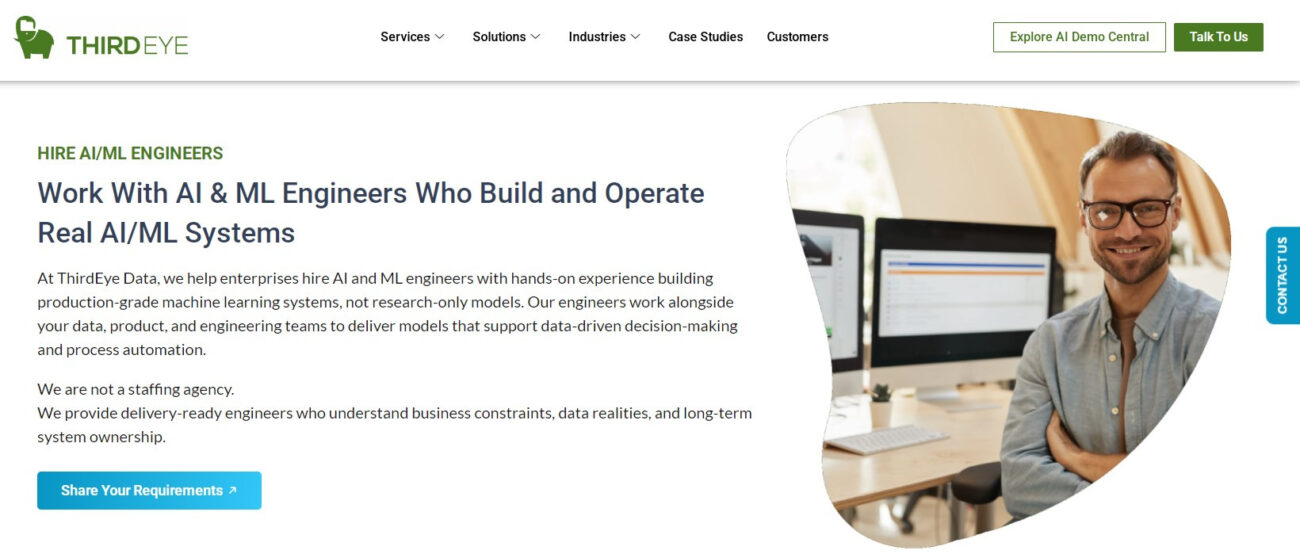
ThirdEye Data offers ML talent solutions for production deployments. They hire AI and ML engineers who understand the gap between notebooks and production systems.
Production deployment strengths:
- Azure-based ML pipelines
- Computer vision models for field inspection
- Honest about what works and what does not
- Adapts to changing requirements during deployment
Comparison Table: Production ML Deployment Capabilities
ScienceSoft ships models to operating rooms. BairesDev runs 150 billion predictions daily. Simform automates the whole pipeline. ThirdEye Data tells clients when a model is not ready.
| Firm | Primary Cloud | MLOps Tools | Max Scale | Key Deployment Feature |
| Avenga | Multi-cloud | Custom workflows | Enterprise | 100% legacy compatibility |
| ScienceSoft | AWS | PredictionIO, Spark | Hospital networks | Offline mobile deployment |
| BairesDev | AWS, GCP, Azure | Docker, Kubernetes | 150B daily predictions | 100K auctions per second |
| Simform | Azure, multi-cloud | Kubeflow, Airflow, Seldon | Enterprise | MLOps as a Service |
| ThirdEye Data | Azure | Custom pipelines | Utility scale | Adapts to changing specs |
The table shows technical differences. But numbers do not tell the whole story. Each firm solves a specific pain point that the others do not touch.
Frequently Asked Questions
Production deployment raises the same five questions for every engineering team. Here are straight answers based on real client work from the firms above.
How long does it take to deploy a model into production?
Avenga delivered the Ayasdi Modeler application from scratch with five core features. ScienceSoft built an MVP first, then added ML capabilities in subsequent releases. ThirdEye Data delivered four production models within the agreed timeline. Speed depends on data readiness and infrastructure complexity.
What happens when a production model fails?
Simform uses TensorFlow Model Analysis and Seldon Core to monitor performance continuously. The system flags data drift, concept drift, and accuracy drops before they affect users. ThirdEye Data simply does not deploy models that miss performance targets. Honest assessment prevents production failures.
Which cloud platform works best for ML deployment?
BairesDev supports AWS SageMaker, Google Vertex AI, and Azure ML. Clients choose their preferred platform. ScienceSoft is built on AWS with HIPAA compliance. ThirdEye Data uses Azure for utility clients. Simform works across Azure and multi-cloud environments. No single best option exists.
How do these firms handle model retraining in production?
ScienceSoft built an administrative panel where platform managers can launch training cycles and evaluate new datasets. Simform automates data updates, feature selection, and hyperparameter tuning as part of their MLOps pipeline. BairesDev includes model versioning and drift detection for continuous improvement.
Can these firms deploy models to edge devices?
Avenga built a fleet management system using Intel’s OpenVino toolkit. The system processes driver monitoring data at the edge inside vehicles. No cloud connection required for real-time fatigue detection. ScienceSoft’s iOS mobile app processes spectrometer scans offline and syncs later. Edge deployment is possible with the right partner.
Conclusions
Production ML separates real engineering from academic exercises. A notebook model proves a concept. A deployed model proves value.
The five firms above handle the hard parts. Avenga makes ML work with existing bank infrastructure. ScienceSoft deploys to operating rooms where downtime is not an option. BairesDev scales to 150 billion daily predictions. Simform automates the entire MLOps pipeline. ThirdEye Data tells clients when a model is not ready.
Ask potential partners one question before signing anything: “Show me a model you deployed last month that is still running today.” Their answer will tell you everything.